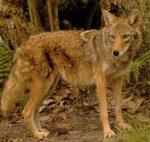
Evolution of a coywolf. (animalpicturesarchive.com)
Lately, “coywolves” have been making headlines and raising eyebrows. They are a wild canid that is a hybrid between a coyote and a wolf. It may sound like an urban legend, but coywolves are real.* I first learned about this quirky common name via a news article from The Star in Canada, Meet the Coywolf (by , which does a surprisingly good job of detailing the coywolf and its increasing run-ins with humans on the eastern edge of greater Toronto. And now, a new study is out offering both a coarse-scale genetic analysis of this new hybrid species, and specific trends in their skull shape.
One thing I find so interesting about this phenomenon is the plasticity of the two species that they can interbreed so successfully. Why is this? Species within the Canis genus have a remarkable ability for crossing the species barrier and procreating under certain conditions. Dogs (Canis familiaris) can mate with some wolves (Canis lupus). Wolves can mate with coyotes (Canis latrans). And unlike other species that create infertile hybrids, the offspring of these pairings can be fertile, so when these hybrid offspring mate and produce their own pups, they introduce new genes into one of their parent populations. For example, when a coyote and a wolf mate and create a coywolf, and then that coywolf lands a coyote suitor and they have their own pups, those pups are born with some wolf genes that are then brought into the coyote population.
Until recently, most of the public’s attention has been directed at the affect of coyote hybridization upon wolves, with little conversation about the effects of wolf hybridization upon coyotes. The general thought in the U.S. seems to be that there are plenty of coyotes — so why worry about them — but since wolves are largely endangered here, we need to protect their genetic diversity from “pollution” by coyotes. But what about the coyotes? How might wolf genes be helping or hurting them?
A new study published Sept. 23 in the journal Biology Letters asserts that coyote-wolf hybridization events in the northeastern U.S. have lent coyotes genes that gave them an extra edge when expanding their range into new territories. The study by Roland Kays, et al. analyzed mtDNA from 686 eastern coyotes and analyzed 196 skull measurements associated with what the authors call the coyotes “two-front colonization pattern.” The two-fronts relate to the coyotes expansion from the Great Plains and then a.) north and east the long way around the Great Lakes, and b.) a straight shot due east from Ohio, the short way below the Great Lakes. Intriguingly, the study states that the coyotes expansion on the longer front north around the Great Lakes occurred at a rate five times faster than the coyotes that expanded along the short route. They attribute this speed to the coyotes exposure to wolves in Canada along the northern route, whereas the coyotes along the southern Great Lakes route expanded in the absence of wolves, which had been extirpated in the previous 90 years. The two expanding fronts then met, giving scientists an opportunity to compare the effects of geographic travels upon each front.
What could make animals from the same parent population expand five times faster in one direction versus another? Kays and his team say that as the northern front of coyotes expanded around the Great Lakes, they hybridized with eastern wolves in Ontario. The injection of wolf genes into the coyote population in this area then led to larger coyotes, which in turn enabled them to hunt deer. Kays and his team also found evidence that the coywolves have a stronger bite than traditional coyotes do, as evidenced by skull musculature. Previously, some scientists had suggested that the larger coyote body size may be due to natural variation (phenotypic plasticity), but the authors state that:
Our results show that northeastern coyote populations are a hybrid swarm resulting from the widespread introgression of GLW [Great Lakes Wolves] genes. This suggests that hybridization introduced genetic variation for the rapid adaptation of more efficient predation on deer, including larger predator body size and skull dimensions.
Their nickname casts a playful tone, but these new hybrids are larger than their western coyote relatives and smaller than wolves. And their larger size is enabling them to hunt larger prey, which has definite ecological implications. According to the Star article at the top of this post, people are reporting that the hybrids act bolder, like a wolf, but have retained the coyotes tolerance for urban areas. While only anecdotal, this does seem to be a logical extension of their larger stature.
The coywolves, then, have benefited from the wolf genes they acquired en route around the northern edge of the Great Lakes, and they are undergoing adaptive evolution. Kays’ study details the case that these animals have undergone a genetic change which has allowed them to use their environment differently (hunting larger prey) while at the same time, their environment has changed in the past century due to the eradication of wolves in the U.S.
What I find so interesting is that the traditionally western coyote acquired genes from eastern Canadian wolves, and brought those genes back to a region where eastern wolves had been extirpated decades ago. I wonder to what degree these new coywolves will have an ecological impact in the east. Will conservation biologists one day be arguing for their protections, if they prove to play a similar role in the ecosystem as the extirpated red wolf, which once occupied land from the southeastern U.S. northward into southeastern Canada? And will people adapt to the coywolf as readily as it has adapted to its new habitat and us?
—
* Addendum (Feb. 2010) I have learned that Roland Kays, whose work is reported on here, does not support using the term “coywolf” to describe these hybrids. This came out in a Boston Globe article published on Feb. 17, 2010.
{1} Based upon the original research of Roland Kays, Abigail Curtis, and Jeremy J. Kirchman. Rapid adaptive evolution of northeastern coyotes via hybridization with wolves. Biology Letters. Published online Sept. 23, 2009. (doi:10.1098/rsbl.2009.0575)
{2} Kind thanks to Dr. Kays for providing me a copy of the study.

 Wild Muse
60 thoughts on “Evolution of a coywolf, and range expansion”
Andrea
I found your article fascinating! I believe these are what I have on my property in New Hampshire as they are larger than coyotes and very beautiful with black markings!
DeLene
Hi Andrea, Thanks for your comment. Where in NH do you live? What have you observed the animals on your property doing? How many have you seen, and where did you see the black markings on them?
Pingback: Tweetlinks, 9-25-09 [A Blog Around The Clock] « Technology Blogs
Carl Buell
I’ve talked with Roland myself (although mostly about fisher) and after living in California and Arizona, find the coyotes here in upstate New York larger and “wolf lankier” than the animals I knew out west. Last winter I had a pair frequent my yard on a number of moonlit nights and got a real good look at them. Having painted animals as a living for 40 years, I think I could easily pick New York coyotes out of a western coyote lineup.
It should be noted that the wolves that populate the western US and Canada, are a second immigration from Asia during the late Pleistocene and are rather distinct from the first immigration group that populate in eastern Canada. Perhaps eastern wolves “grew up” with coyotes here in North America and are more receptive to coyote mating than their later arriving western cousins.
DeLene
Welcome Carl Buell, and thank you for your comments. Your illustrations are wonderful. I first learned about your work when I was a staff writer at the Florida Museum of Natural History. They have a painting of yours in their fossil hall that (if memory serves) is a scene from the Pliocene, complete with a terror bird.
Thank you for including your observations from upstate New York. I’ve only recently learned about coywolves, but I’m collecting news accounts and trying to learn more about the research being done. Kays paper is really eye opening. (I first learned about his work when I read “Darwin’s Fox and My Coyote” last year.) You are correct that Nowak has proposed several waves of immigration by wolves into North America from Asia, at least two major waves resulting in the eastern and western wolf populations we have today. (The account I have read is in “Wolves: Behavior, Ecology and Conservation,” edited by Mech and Boitani.) I didn’t want to get into wolf taxonomy issues on this post, as I am still researching the nuances, but yes, I am aware of the taxonomic issues and concerns between eastern and western wolves. It seems another revision to wolf taxonomy is inevitable. I too am very curious why eastern wolves in Canada (Canis lupus lycaon) — and red wolves in N.C. (Canis rufus) — seem more susceptible to hybridization with coyotes than do other wolves. I don’t think even the experts fully understand the mechanism of susceptibility at this point, but there are plenty of ideas floating around. Thank you for your comments, Carl, and for all you do to bring natural history alive for us.
c ratlins
We have seen two of these described animals in Burnaby, BC. We now live in the Fraser Valley and there are accounts of sightings of “Coywolves” in this region. Surely someone is doing DNA analysis of them here. I watched a video some time ago made by researchers of the Eastern “Coywolves” and read some articles about them. I recall that when they analyzed the feces of “Coywolves” whose dens the researchers were watching and the stomach contents of at least one male which had been shot, they concluded that the hybrid did not pose a greater threat to humans or their pets because they appeared to be hunting smaller mammals. Their observations led them to believe that the hybrid was not aggressive toward humans.
What are the suggestions about classifying and naming the hybrid?
DeLene
I’m not aware of anyone studying coyote-wolf hybridization in British Columbia. As I replied to Melissa earlier today: “They are only known to occur in the East, and even within the East they are predominately concentrated within the northeastern states. It’s a specific species of wolf, Canis lycaon, (thought to not be of gray wolf origin) which has hybridized with coyotes to produce the “coywolf” also known as Canis latrans x Canis lycaon hybrids.” You could also add extreme southeastern Canada to their range. You are correct that they are small mammal specialists, though they are also known to take down deer. Jon Way of Eastern Coyote Research has been pressing the issue to give these hybrids the common name of “coywolf,” though other researchers caution it’s too soon to give them a common or scientific name. What’s happening here shoots at the heart of the species problem, which I wrote about extensively in this earlier post. When it appears a population of hybrids have begun breeding only or mostly amongst themselves, then that might be interpreted as the beginning of a speciation event in which they may be embarking on their own evolutionary trajectory independent of their parent populations. If so, they may be given a scientific name. However, if individuals within the hybrid population continue to backcross into either parent population, and the breeding barriers remain more porous than closed, then scientists would likely not want to give the hybrid population a scientific name.
Pingback: Genes, Categories and Species, by Jody Hey « Wild Muse
Al Mac
We recently had a large “beast” in our back yard in central CT. We sent a couple of photos to the state, which replied that the “beast” was a coyote. Never seen one like this.
DeLene
Hello — thanks for visiting. If you’d like to send a copy to me, I’d be happy to post it here. (delene {at} nasw . org)
Pingback: Coywolf encounter in Connecticut ? « Wild Muse
johnypaycut
t’was baited by a coywolf (outside my cabin yipped for over a hour) finally got sick, went outside and the little s.o.b. simply
continued his racket. i could not chase him off. i finally grabed
a 2×4 and gave prusuit (25ft.) he ran off ,and as i heard ’em go he was greeted by his pack(3wild dogs) if i’d chased him,
i would have been bushwacked.
happened in 2006 saugerties ny.
6months earlier i saw a 50lb alpha male in the woods, 20ft
away, he was a scout.
the rascals are actually dangerous, it will eventually come down to a war, human vs. coywolf. cops in saugerties are
not willing to do a thing? (lazy) so we have to act.
DeLene
If you felt fear, Johnypaycut, it was only because you fell victim to the mythological fear of wolves and wild dogs that resides in our culture. I assume you weigh more than 150 pounds and are male, right? And you were afraid of a dog 1/3 your body weight? You do not have my sympathies. I have camped in the Blue Range Wolf Reintroduction Area in Arizona, and heard three Mexican wolves howl throughout the night while I was in my tent — alone and unarmed by choice. I was not afraid. Quite the opposite — I was enchanted by their songs and I could hear them calling each other, calling until they were all three together and traveled from west of me to south of me. Humans are not, and never have been, the prey of coyotes or wolves. You are more likely to be injured by your fellow man (or yourself) than by one of these animals. Please, keep the relative risk in perspective and do not fan the flames of the fire that drove wolves of the east to near extinction a century ago. Coywolves, in my mind, deserve special federal protection — not a 2×4 being dragged through the forest by someone who completely misunderstands them and would wipe them out for no other reason than to assuage his own fear.
Sean M
I agree, for the most part fear of wolves or coyotes is largely unfounded however, I live on a reserve in Northern Ontario that is only accesable by plane. Last fall we had several large wolves coming into town and attacking puppies. Over the course of a few weeks the wolves became more and more brave and our community felt that they were losing their fear of humans and were becoming a danger. Before Halloween several of the wolves that frequently came into town were shot. This was done because eventually the wolves would have targeted children. The rest of the pack then moved away from the town and stoped being a problem. Elders in the community who had lived here for decades said that this was a very rare event and had never happened before…but it does happen.
I also have heard of several attacks on people from both wolves and coyotes, while I am not afraid of either animal one must remeber that these are wild predators who will not fail to exploit an easy meal. Fatal attacks are almost unheard of (there has only been one proven fatality from wolves in all of Canada and it was very recent and involved wolves that were living at a dump and had lost their fear of humans). Coyote attacks are actually more common because they are not as fearful of human. A woman was killed two years ago by two Coyotes on Cape Breton Island. If you see a wolf or coyote, dont try to talk to it or pet it, definately dont feed it but you also dont have to declare war on them, for the most part they will try to avoid us, they only become dangerous if they are starving or if they have lost their fear of humans. I would also like to mention that these wolves are extremely large up here, not hybrids but pure gray wolves. It is not uncommon for them to reach 150 lbs… yet attacks on humans almost never happen.
DeLene
Hi Sean, you make some great points. Thanks for sharing your experiences and letting us know what’s going on in Northern Ontario.
Scott
Just curious how you would argue federal protection? They seem pretty proliferate from what I am reading. I don’t see how they are at risk. Furthermore, one cannot tell exactly what percentage of wolf is in each coyote and coyote are fair game here in NY for hunters and trappers. If not kept in check coyotes could easily decimate the turkey population, could larger one pose a threat to whitetail deer? I say it’s possible. You obviously are very educated and your writing is great but I would urge people to consider unintended consequences of trying to protect a species that perhaps needs no protection at all. I am not a wildlife biologist in NY, I am not saying I have THE answer or that you are wrong to believe what you do. I am a hunter and conservationist, I believe I have seen a coy wolf while deer hunting and he was pretty spectacular and I enjoyed it very much. However, wildlife conservation must take into account all species and many other factors as well.
don strausburg
Although the studies of coy wolf hybridization that included a sample from a coyote here in western Ohio did not indicate hybrids, I believe they are now here. I have seen them hunting deer. I have seen them road killed. They are very large. However, The deer population has not been diminished. I have to turn people away who want to hunt on my property. It’s a popular place to hunt. The rabbits are still here. The raccoons are still here. I lose a lot of cats though. I do not feel the coy wolves are going to crash any wildlife populations.
Scott
Fair enough. Sounds like you have some beautiful land. Don’t get me wrong I’m not saying we should extirpate the coywolf by any means. I have no problem having them around. Thus far they don’t seem to be causing any significant problems. I’m simply saying that when it comes to protecting wildlife we need to look at the whole picture and do our best to manage all of the wildlife.
Sadie
Great article and thanks for the pictures. I am fairly convinced we have these fascinating hybrids here in Rhode Island. Was walking with a friend and her dog when we spotted one hiding in the tall grass. Sure enough, another bounded across the trail and joined its pal. We spotted another on the other side of the trail; all watching my friends chihuahua. We continued walking, but when they didn’t budge as we got closer we decided to turn back. We could not help but notice how big they were compared to what we thought of as typical coyote size. These were easily 60lbs.
My husband and I hear them in the woods behind our house fairly regularly and the high-pitched howls always draw our eager eyes to the window. We have spotted them trotting through the yard on occasion. The paw-prints they leave behind are also quite large (approx 3 inches by 4 inches or so).
It is nice to know there is some fact behind our suspicions!
Pingback: Carnival of Evolution #21: The Superstar Edition « Mauka to Makai
John C. Severance
Thank you for publishing this topic and webpage. I have attempted to study these ‘new’ critters for quite sometime now in northern NH and have been fortunate enough to see many individuals and photograph a few, which show a clear variation in individuals, but not many characteristics of the traditional western coyote.
The introduction of wolf genetics makes so much more sense than theories that the ‘cold rugged northern’ environment somehow ‘grows’ these critters or the coyote/ domestic dog cross (coydog) earlier notions.
In researching the ‘eastern coyote’ the number of studies inclusive of genetics, particularly the more recent Maine Study, seem to indicate coyote/wolf hybrid of varying degrees. Once again it seems like the most reasonable explanation.
I look forward to further research and studies.
John
DeLene
Hi John, Thanks for your comment; I would love to see some pictures of the animals you have seen. Can you email some to me at delene {at} nasw.org? Where have you observed them, and what was their behavior like? I live in NC so have not had much exposure to these hybrids in real life, other than reading the literature, which is endlessly fascinating. Are you talking about Jon Way’s study, when you referenced the recent Maine study?
Carlos Trenary
I saw what I believe to have been a coywolf here in Nashville 2 years ago. And today one of the local neiborhood groups had a blog post reporting a coyote 1 1/2 to 2 x the normal size of a coyote. I’ve seen many coyotes over the years and what I saw here was a more robust coyote than I have ever seen.
Pam Bacon
Hi, I live in the edge of the Ozarks in Southeast Missouri. A few years back my husband came across a small puppy, no older than 5 weeks old, walking down the middle of the road. He stopped and checked with the couple of houses that were near and no one was missing a dog so he brought it home. Didn’t think too much about it at first because unfortunately finding abandoned dogs is very common in our area. He grew up to be a beautiful dog, everyone comments on his vivid eyes and overall beauty. One day we were at the doctors office and were reading a Missouri Conservationist Magazine and on the back cover was the story of the red wolf mixing with the coyotes before they became extinct in our area. To our complete shock the picture with the article looked almost exactly like our dog! He also has certain “wild dog” traits like walking with his head down like he’s stalking something. He has been a handful at times. We are not newbys when it comes to wild dog mixes and agressive breed dogs. We had 4 dogs at one time, a German Shepard, a Chow mix, a wolf/shepard hybrid and of course the one I mentioned before. We lost two of our dogs in the last few years, the German Shepard had a heart defect and should have never lived past being a puppy, she was 5 when she died, and our Chow which was 15 yrs old. So now we are down to the wolf/shepard and our suspected wolf/coyote. Our Vet is impressed with both dogs and how well we have them trained. I must say to anyone who wants a wolf hybrid, these “wild” dogs are pack animals, if you want to own one you MUST be the pack leader at all times! Only then can you have a happy, well behaved, controlable dog.
Pingback: More hybrid lovin’: coywolves, wolves and coyotes… « Wild Muse
Kay
Hi,
We are just moving to Prescott, AZ. I almost struck an animal with my car that perfectly fit the discription of the Coywolf. I told my husband I almost hit a wolf, he said it had to be a cayote…my very words to him was it was the size of a german shepard! It was straglier looking than the photo, but was definately the size of a German Shepard. This happened on the edge of the Prescott National Forest between Prescott and Prescott Valley AZ. Is it at all possible it could have been a Coywolf? It was far larger than a Cayote. Not a week later, coming down from Bradshaw Mountain in Prescott, I encountered what must have been a large stragley black ferrel dog, that looked very much like a real wolf. It was dark gray that got lighter, and must’ve been feeding well on house pets, because it was not thin as the other one was. This too was less than a mile from the Prescott National Forest, one was in a residential area, the other headed into one. Think I’ll have a covered kennel for my doggies at our new home which is on top of Bradshaw Mountain and butts to Prescott National Forest.
Thank you for the information. I have a feeling I’m going to be learning much about living with whatever these animals are.
DeLene
Hi Kay, It was most probably a coyote, or possibly a wolf-dog hybrid. (I’ve heard from several people there is a problem in AZ with people keeping wolf-dog hybrids, then letting them loose, or they escape. I have no clue about the frequency with which this happens, just know it’s an issue in the state.) The coywolf phenomenon is geographically restricted to the Northeastern U.S. and involves wolves of the extreme northeastern Great Lakes (around Algonquin Provincial Park in Ontario) breeding with coyotes, the offspring of which then traveled into New England where “coyotes” that are 45 to 60-ish pounds have been showing up. Alternatively, you may have seen a Mexican wolf that had wandered outside of the Mexican Gray Wolf Recovery Area, though this is less likely. The Fish and Wildlife Service used to post a map with pack locations, you could look into that and see if there is maybe one that’s been wandering. Either way, I would definitely keep my pets inside!
DeLene
P.S.: there are no known instances to my knowledge of gray wolves and coyotes breeding in the West, this seems to be restricted to this one population of NE wolves…
don strausburg
I don’t seem to be able to read studies pertaining to coywolves in Ohio. People here in Miami County are mistaking them either for wolves or German Shepards. I have watched them stalk deer behind my house. I have found deer parts that contain multiple skulls in one hidden location. Certainly these are not coyotes. Miami Co. Ohio would be as good a place as any to conduct a study.
Dr. Jake
Seems the number of coyotes I’m hearing at my camp has markedly increased and they venture much closer to the cabin than before. Perhaps because of an unusually mild winter and resulting increase in prey? I suspect those that I captured in a game cam last fall are, in fact coy-wolves, as they seem far larger than a typical coyote. Are coywolves sociable with coyotes or do they exhibit agression towards one another? Of note is that several timberwolve’s carcasses were said to have be found late last year. They were thought to have been extirpated since the turn of the 20th century. The debate is now whether they should be allowed to retake the adirondacks, stressing coyote and deer populations.
david
I’ve just found out about these the coywolf because I saw an odd what I would call a tall giant fox. Then a friend told me that we actually have wolves in our area so I googled “wolves in New England” and saw a pic of the animal that was in my yard, a coywolf. I live in Westerly, Rhode Island and this beautiful animal just ran though my yard. Still I hope it doesn’t have any “friends” and doesn’t come back soon. I would say the coywolf was about 3 feet tall a about 50 pounds with a large bushy tail with the coloration of a gray fox.
Dr. Jake
I’ve read of some biologist’s concerns over the coywolf. The coyote’s pack hunting behavior, now coupled with the wolf’s larger size and aggression could be problematic to some species. It’s as though the coyote got bigger and meaner, and the wolf, a lesson in group-hunting. Perhaps the coywolf would be better suited to hunt prey that may have eluded the coyote, and conversely, a clever pack could out-hunt a lone wolf. Changes in predation would affect populations of prey and in so doing, indirectly affect an entire ecosystem. This is evolution before our eyes. Fascinating.
SJ
My daughter will be living in a cabin off the grid near St. George Lake in Maine for the winter. Her closest neighbors are about 2 miles away. The owner of the cabin told her that there are coyotes in the area and suggested that she take a shot gun with her when she goes out. My daughter isn’t a hunter and doesn’t have the comfort level with guns to do this. I am assuming that these could be coywolves. She will be there during breeding season and will have a cat as a pet. What advice do you have for her?
SJ
I should have mentioned that my husband and I were in Nova Scotia shortly after the woman was killed there on Skyline trail. Also while we were there a girl was bit on the head while sleeping in a camp ground. My son died 5 years ago in a car accident and she is my only child now. So I’m a nervous wreak. I know that western coyotes can be scared off, but worry very much about this new breed which has been shown to be aggressive.
DeLene
Oh goodness, I’m not in a position to be giving safety advice! Maybe you can find out what local wildlife agency oversees that area and talk to someone local there about what kinds of coyotes are present and what kinds of problems have been reported? Obviously, the cat should stay inside if there are coyotes around…
HCR
We live in Burnaby, BC near a conservation and park area off Hwy 1. We have seen two of these animals here beginning sometime in late fall 2012. At first I believed that they had to be a German shepherd-coyote cross, but they look and are sized exactly as the photos I now see on the net. I thought there was one, until I saw two together. They seemingly have no fear of people – trotting down the side walk adjacent to green space and/or the street in front of our house. To date no one has reported seeing them threaten local dogs or people. I wonder if someone has introduced a pair to our area.
chantel
We had an unfortunate incident yesterday am with a pair in our back yard in Penticton. 5′ from our back door they killed my hefty 20lb cat. I managed to scare them off before they took him. But, I also described them as German shepherd looking with a fox like fluffy tail, and an auburn coat with grey/white tones. We live a block from two major streets and the hospital. Cat population seems to be scarce in the last month… Called the conservation officer to report the ‘huge coyote’ pair. My fear is for the small children in the area and the elementary school…
crawlins
There are some interesting videos about coywolfs – mainly by researchers here and there. Coywolfs apparently are less aggressive than wolfs or coyotes. They seldom go after pets unless their food supply has been disrupted. They are comfortable in and found in urban neighborhoods. I think that people are afaid of them because of their size, and because they seem to be confident and unafraid. They are very smart and hide well. Their only predator as far as I know is the human. If anyone has updated citations about those guys, please let us know.
Cherie
DeLene
Hi Cherie, You would probably be interested in the work of Dr. Jon Way, if you have not already found him. Visit http://www.easterncoyoteresearch.com for more. Best, DeLene
Leigh
My grown son and I saw a coywolf on Wednesday 8/31 2013 coming out of the 6500 acre Elm Creek Park Reserve. It was much bigger than a coyote, buff colored, wolf tailed, about 100 feet in front of our car. It was almost the size of our 75 pound collies ( minus the luxurious coat). We live near Elm Creek Park reserve in Dayton, MN. My son has also seen them on farmland about 3 miles from here. I’m not sure if the howling we hear at night is a pack of coyotes, or coywolves. My sister lives in Grand Marais, MN on the Gunflint trail in a remote area. When we visit, she and I howl to the wolves at night ( and they answer! ). She says we do it to establish territory. The howling I hear at home is much different from the wolves in Grand Marais. When the coyotes howl and I answer, they stop howling and yipping. What do coywolf howls sound like?
Leigh
Sorry- the date of the sighting was 7/31/2013
Rob Davis
Proof that Darwin was right, and I think God would agree with me. :-)
Stanford Joel Kirshtein
I live on Sullivan’s Island, SC. We seemingly have a large coyote population here on the island. I’ve captured dozens of videos with my trail cam. They seem to be larger than the norm for coyotes. Might coywolves have worked their way down here? You can see them on my videos here: http://www.youtube.com/user/stanfordjoel
DeLene
I have not heard of, nor read, any evidence that coywolves have made it much farther south from New England than the mid-Atlantic (and even there, not at all common). I looked at a few of your videos and the coyotes appear to be in the normal range to my eye.
Stanford Joel Kirshtein
It sure would be interesting to do some DNA testing on the ones we have here. We do know they travel and grown pups often have to look for new territory. As the crow flies, it’s not that far and not inconceivable that the coywolf would make it’s way south. I’ve heard that they have been identified as far south as Virginia and North Carolina.
Marianne
There is going to be a special on PBS Nature about the coywolf Jan 22, 2014 8PM
Roxanne B
I have a few pictures of what I believe to be coy wolves I would really love some confirmation… please contact me if you can Thank you
DeLene
Hi, while I can look at them, please know it sometimes takes a genetic test to verify whether a coyote carries wolf genes. My email is on the About page of this blog.
Roxanne B
Thank you :)
Sandy Coryell
I am curious. Last spring we had a small fox and her kit visit our backyard several times. I still see the fox but not as often. Now I am seeing what looks like a fox, small head and red coloring, but it has longer grey legs. Could this be a hybrid of some kind?
DeLene
I’m not familiar with hybridization among foxes, sorry I can’t be more helpful.
Schrodinger
Foxes cannot interbreed with the ‘wolf canids’ like wolves, coyotes or domestic dogs because they do not have the same number of chromosomes.
DeLene
Funny, I didn’t interpret the original question to indicate hybridization between Canis and foxes, just among different fox species.
slcoelho
I believe the coywolf has successfully migrated to the Pacific Northwest. We live in the Fraser Valley, BC, and have seen 3 which look EXACTLY like the specimens on this program. They are large, long-legged, with thick coats and tails. At first blush they look like small wolves, only with the tan coat and slightly sharper muzzles. There is a den of them just down our street (we live on rural property), they’ve been there for at least 9 yrs; you can here them most nights. Also several years back, the news reported attacks on humans, in the City of Vancouver, by large, aggressive coyotes. o_O
DeLene
I’d be absolutely stunned if the animals in your area were traceable genetically back to the coyote x eastern wolf hybrids of the eastern Great Lakes. There are no valid reports (that I know of) regarding these animals anywhere other than parts of New England and extreme eastern Canada.
Melissa
I have a photo of what I believe is a Coywolf that I saw here last year in Northern California. Wanted to confirm?
Let me know…
DeLene
It’s highly unlikely. They are only known to occur in the East, and even within the East they are predominately concentrated within the northeastern states. It’s a specific species of wolf, Canis lycaon, (thought to not be of gray wolf origin) which has hybridized with coyotes to produce the “coywolf” also known as Canis latrans x Canis lycaon hybrids.
herderlodge
DeLene, having a camp in the middle of 1000 acres in central New York’s Adirondack Mountains, my game cams regularly pick up packs of what appear more like wolves than coyotes. Of course I also see my fair share of smaller, longer, thinner coyotes. What I assume are the coy-wolves are much larger in stature to be sure. But I also note that they yelp and yip like coyotes. How has the blend of coyote and wolf manifested itself when it comes to their behaviors? Do they tend to pack socializing or prefer to be alone? Are their vocalizations yips and yelps or more wolf-like? Aggression level? I’d love to hear whatever you can share.
Glenn Jørstad Jakobsen, DO, FAAPMR, FABDA, Med.Acup. Attending Physician, North Shore/LIJ Health Care System Department Surgeon, New York State Police
DeLene
Hello Glenn — what a unique experience to have footage of the wild canids in this area. Have you thought about uploading any of the scenes to YouTube? If you do, please email me a link. As to your question about behaviors, I’m not an expert but my understanding is that the hyrbids have retained the coyotes’ tolerance for living amongst people and our built environments, which is a trait wolves never acquired. However, their family structure may resemble wolves more closely in that they have extended family members living with them (pups from the previous years’ litter). The slightly larger family groups, in association with physical changes to the skull and jaw which accomodate heavier musculature than a western coyote, combine to allow the hybrids to hunt deer successfully — something western coyotes do not do. Hunting larger prey requires not only a stronger jaw for biting and handling the prey, but also cooperation among packmates to coordinate a hunt — a trait wolves are known for, but that coyotes are not (coyotes are more typically solitary hunters). I can’t aswer your question about vocalizations for sure (though I’d posit it’s deeper sounding, with a mix of yips, yelps and howls), but I can direct you to Eastern Coyote Research, where researcher Jon Way has written and published extensively on coywolves. I don’t believe they are agressive to humans in most circumstances, though any wild animal which becomes habituated to humans or our food is dangerous.
sherry. lewallen
Are these coywolves common in southeast Missouri